
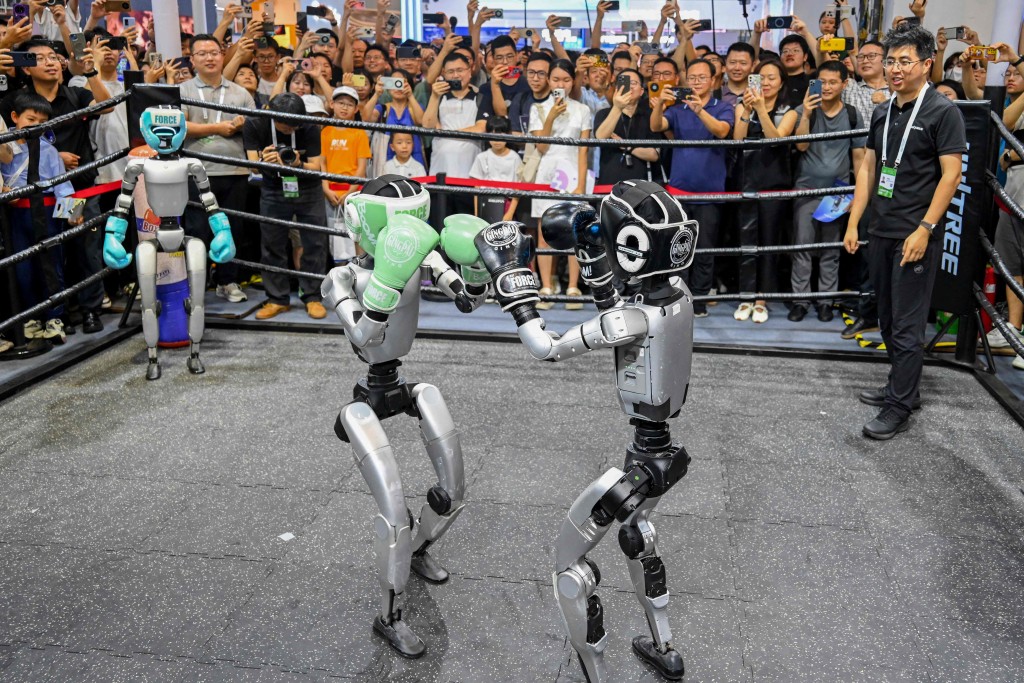
At the World Artificial Intelligence Conference (WAIC) 2025 in Shanghai, a live humanoid boxing match stunned audiences when two G1 robots from Unitree Robotics stepped into the ring. In a gripping two-minute demonstration, the robots showcased realistic combat moves—delivering punches, executing defensive maneuvers, and reacting with near-human coordination.
China’s Robot Fighters Steal the Spotlight at WAIC 2025
The World Artificial Intelligence Conference (WAIC) 2025 in Shanghai has once again proven to be a global showcase for cutting-edge technology, and this year, China’s robot fighters have captured the attention of attendees, media, and tech enthusiasts worldwide. Combining artificial intelligence (AI), robotics, and military innovation, these autonomous machines are demonstrating capabilities that are setting a new benchmark for robotic combat technology.
The Rise of China’s Robot Fighters
China has been steadily investing in autonomous robotics and AI-driven military applications over the past decade. At WAIC 2025, the focus has shifted from theoretical developments to practical demonstrations. The robot fighters unveiled at the conference are designed to operate autonomously or semi-autonomously in complex scenarios, utilizing advanced sensor arrays, machine learning algorithms, and real-time decision-making systems.
These machines are intended for multiple applications, from defense and security operations to experimental combat scenarios. By integrating AI-powered navigation, target recognition, and combat decision-making, these robots exemplify China’s strategic push to lead in the field of autonomous military technology.
Highlights of WAIC 2025 Robot Demonstrations
During the conference, the robot fighters performed live demonstrations that left spectators impressed. Key highlights included:
- Autonomous Movement – Robots navigated complex terrains without human intervention, avoiding obstacles in real time.
- Target Engagement – Using advanced sensors and AI algorithms, the robots identified targets and executed precise maneuvers.
- Team Coordination – Multiple units demonstrated the ability to operate in coordinated formations, communicating and adjusting strategies dynamically.
- Durability and Agility – High-performance actuators and reinforced structures allowed robots to withstand physical stress while maintaining rapid movement.
These demonstrations showcased not only technical sophistication but also practical combat readiness, positioning China at the forefront of robotic warfare innovation.
AI and Robotics Integration
One of the most remarkable aspects of China’s robot fighters is the seamless integration of artificial intelligence. AI enables these robots to analyze real-time data, predict opponent behavior, and adapt tactics accordingly. By learning from each encounter, the robots continually improve performance, making them increasingly effective in dynamic environments.
Advanced computer vision systems allow for target recognition and threat assessment, while machine learning algorithms optimize movement and engagement strategies. This integration of AI and robotics represents a significant leap forward in autonomous military technology, blurring the line between human-controlled and fully autonomous combat units.
Strategic Implications
The emergence of autonomous robot fighters has major implications for global defense strategies. By demonstrating functional, AI-powered machines at WAIC 2025, China signals its intent to lead in next-generation combat technologies. These developments could reshape military doctrine, emphasizing robot-human collaboration and autonomous operational capabilities.
Analysts suggest that robot fighters could reduce human risk in combat, enhance operational efficiency, and allow rapid response in high-stakes scenarios. The presence of such advanced systems at WAIC underscores China’s strategic focus on AI-driven defense innovation and its commitment to becoming a global leader in robotic technology.
Public and Industry Reaction
The WAIC 2025 audience, including tech enthusiasts, defense experts, and investors, reacted with excitement and intrigue. Social media buzzed with images and videos of robot demonstrations, generating discussions about the future of autonomous combat systems and their ethical, strategic, and technological implications.
Industry insiders praised China’s achievements, noting that the robot fighters at WAIC 2025 not only highlight technological prowess but also demonstrate the potential for AI and robotics to transform military operations worldwide.
Looking Ahead
China’s focus on robot fighters at WAIC 2025 represents a clear signal that autonomous military robotics is becoming a core area of national innovation. Future developments are likely to include enhanced AI algorithms, improved mobility, and integration with larger defense systems, pushing the boundaries of what autonomous machines can achieve.
As technology continues to advance, the world will watch closely to see how these robot fighters influence military strategy, international security, and the broader robotics industry. WAIC 2025 has firmly established China as a key player in AI-driven defense innovation, and the spotlight on robot fighters is just the beginning of a new era in autonomous combat technology.
Conclusion
The 2025 WAIC has highlighted China’s remarkable progress in robotic combat technology, with autonomous robot fighters stealing the spotlight. Through demonstrations of AI-powered decision-making, coordination, and agility, these robots showcase the potential for next-generation military operations.
China’s strategic investments in AI and robotics signal its ambition to dominate future autonomous military technology, and WAIC 2025 has made it clear that robot fighters will play a crucial role in shaping global defense innovation for years to come.
About The Author