

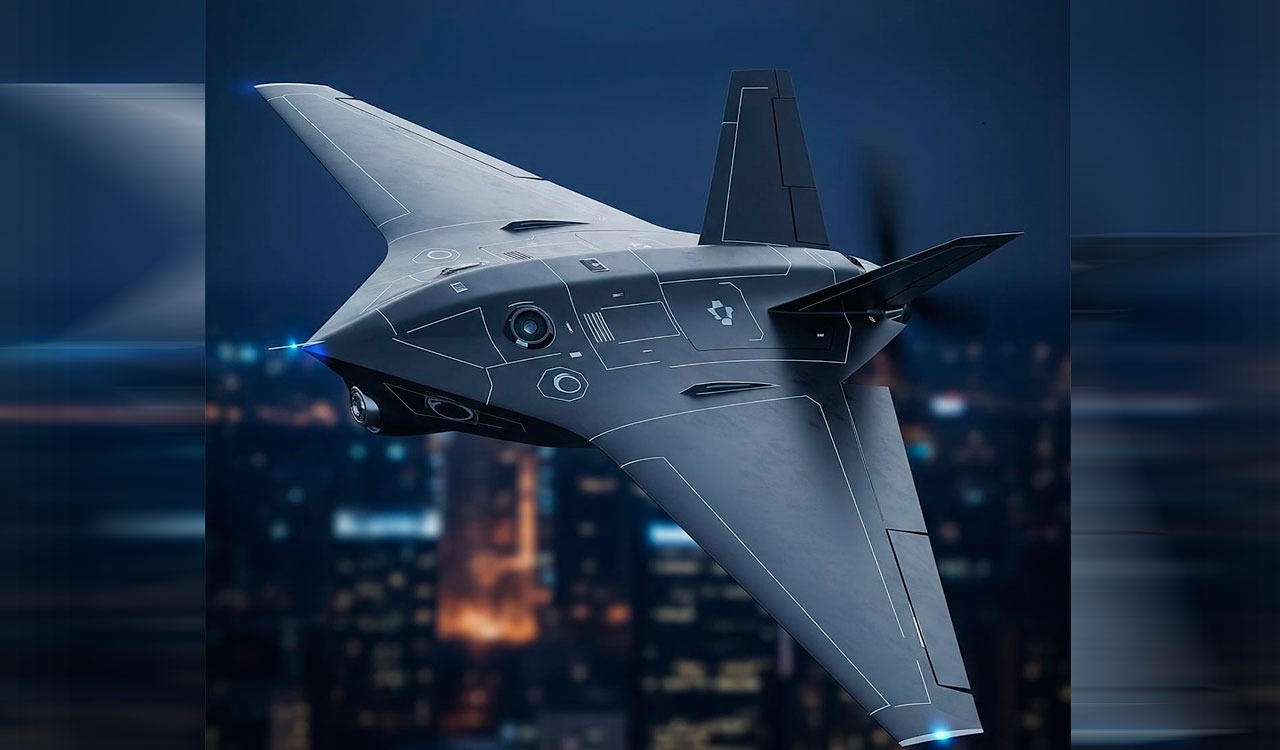
India Develops Dual Stealth Drone Wrapped in Nanotech Cloak in a breakthrough defense collaboration between Veera Dynamics, Binford Research Labs, and IIT-Hyderabad under the Ministry of Defence’s iDEX initiative. This drone features the innovative RAMA (Radar Absorption & Multispectral Adaptive) coating—an advanced carbon-based nanotech material capable of absorbing both radar and infrared (IR) signals.
India Develops Dual Stealth Drone Wrapped in Nanotech Cloak

India has made a breakthrough in military technology with the development of a dual stealth drone wrapped in a nanotech cloak. Unveiled in 2025, this advanced UAV represents a new era in autonomous aerial warfare, combining stealth technology, artificial intelligence (AI), and nanomaterials to create a drone that is highly maneuverable and virtually undetectable. Defense experts are calling it a game-changer in modern military operations.
Breakthrough in Stealth Technology
The standout feature of India’s dual stealth drone is its nanotech cloak, which significantly reduces radar, infrared, and thermal signatures. This stealth capability allows the drone to operate in high-risk zones without detection, giving the Indian Armed Forces a tactical advantage. By using nanomaterials, the drone can adapt its surface properties to environmental conditions, enhancing invisibility in diverse operational scenarios.
Experts believe this positions India among a select group of nations developing next-generation stealth drones. The dual-drone system enables coordinated missions, with one drone acting as a scout while the other performs precision tasks, making it ideal for reconnaissance and combat operations.
Dual-Drone Design and Capabilities
The dual stealth drone system consists of two UAVs designed to operate autonomously or via remote control. Equipped with advanced sensors, AI-driven navigation, and real-time communication, the drones can make split-second decisions during missions.
Key features include:
- Autonomous Target Detection – Using AI-powered computer vision, drones identify threats and analyze battlefield conditions.
- Precision Strikes – One drone can execute precise operations while the other provides surveillance.
- Swarm Coordination – Drones communicate seamlessly, adjusting tactics in real-time.
- High Maneuverability – Aerodynamically optimized design and lightweight construction ensure superior agility.
These capabilities make India’s dual stealth drones ideal for tactical operations, border surveillance, and strategic missions, providing unmatched flexibility.
AI Integration
A defining aspect of India’s dual stealth drone is the integration of artificial intelligence. AI allows the drones to adapt to changing environments, avoid obstacles, and predict enemy movements. Machine learning algorithms enhance decision-making, enabling drones to learn from each mission and improve performance over time.
The combination of AI and nanotech creates a system that is stealthy, adaptive, and intelligent, capable of operating where traditional drones may fail. Defense analysts suggest this represents the future of autonomous combat systems.
Strategic Implications
The deployment of dual stealth drones has major implications for India’s defense strategy. These drones can reduce human risk, enhance situational awareness, and provide rapid response in high-threat zones. Their stealth and intelligence allow operations behind enemy lines, gathering intelligence and executing precise missions with minimal detection.
By showcasing this technology, India signals its intent to lead in autonomous military systems. Analysts note that nanotech-enhanced drones could redefine modern warfare dynamics and position India as a global innovator in robotic and AI-driven defense.
Global Reaction
The unveiling of India’s dual stealth drone has drawn attention from defense experts, tech enthusiasts, and industry leaders. Social media and news outlets highlighted its potential to revolutionize aerial combat and reconnaissance. Industry insiders praised India’s achievement, emphasizing the growing importance of AI, robotics, and nanotech in defense innovation.
Future Prospects
India’s dual stealth drone program demonstrates the nation’s commitment to cutting-edge military technology. Future developments are likely to include enhanced payload capabilities, longer flight endurance, and improved AI algorithms, further advancing autonomous combat capabilities.
The integration of stealth, AI, and nanotechnology positions India at the forefront of next-generation military drones, ensuring its armed forces remain competitive in rapidly evolving technological landscapes.
Conclusion
India’s development of a dual stealth drone wrapped in a nanotech cloak marks a significant milestone in modern military technology. With its advanced stealth, AI integration, and dual-drone coordination, this system is a game-changer for reconnaissance, combat, and strategic mission.
About The Author